







Platform
Computer

Every agent gets
its own computer.

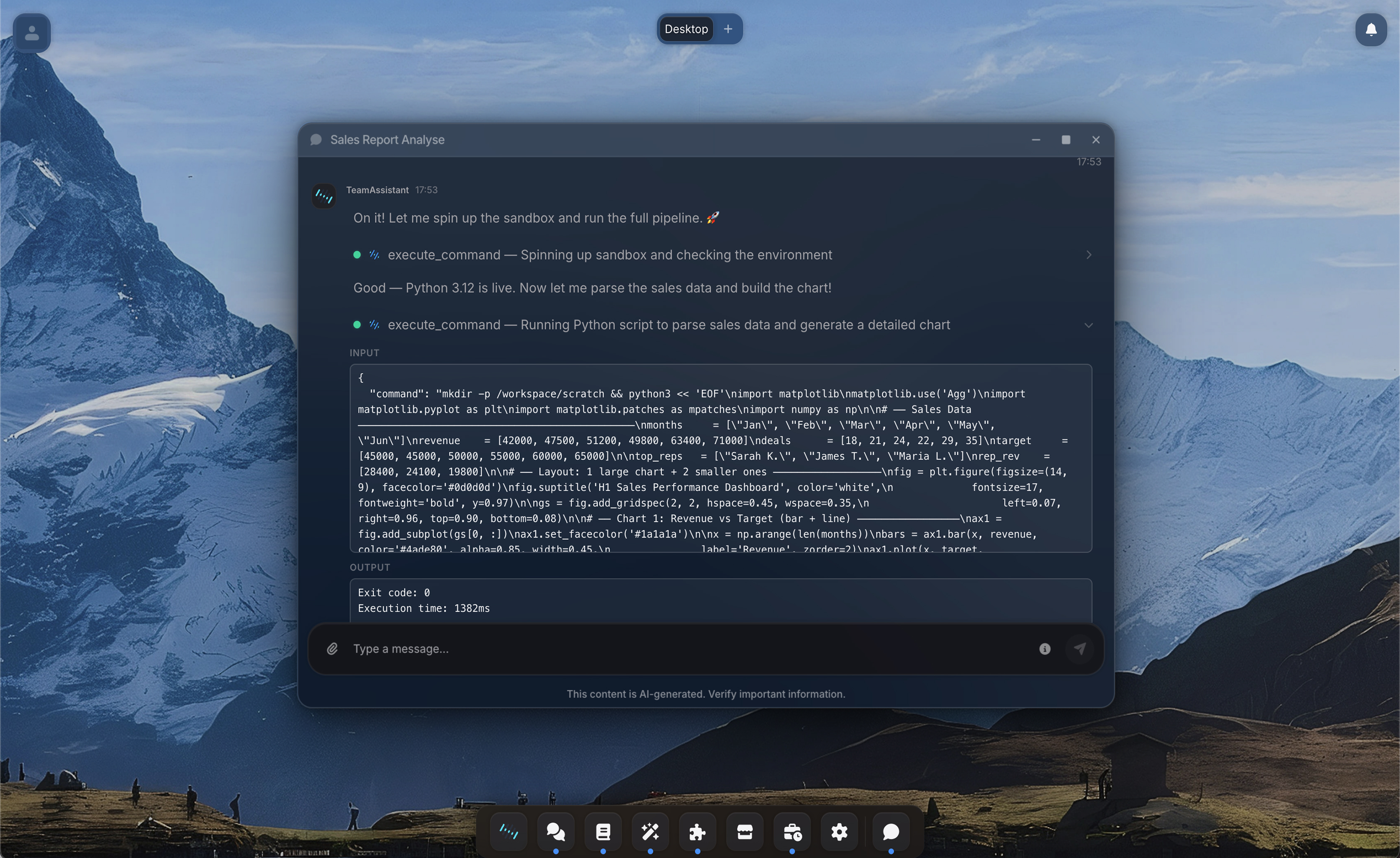
Your agent has a full Linux environment where it writes code, processes files, calls APIs, and builds its own workflows. All within an isolated sandbox that only it can access.

Start FreeBook a Demo
Sandbox terminal with live code execution
Vaults
Agent Studio
Apps
Computer
Connections
Desktop
Marketplace
Scheduled
Security
Computer
Capabilities

What the computer makes possible.

Direct vault access, self-improving workflows, and real code execution in a secure sandbox.

01

Your knowledge base is a file system.

Traditional AI tools retrieve snippets from a search index. Your Team Assistant agent mounts your entire vault as a file system. It can read any file, write new ones, search across folders, and organize content. When the agent processes an invoice, it reads the template from your vault, generates the result, and saves it back. Direct access to everything, in context.

Your Vault
MD
PY
CSV
02

Agents that write their own workflows.

The first time your agent processes expense reports, it calls tools one by one: read the receipt, extract the amount, check the policy, log the result. The tenth time, it writes a Python script that does all four steps in a single execution. One sandbox call instead of four tool calls. Faster, cheaper, and the script is saved to your vault so the next conversation reuses it.

Chat input
Agent writes script
Executes
03

The agent installs what it needs and runs it.

Agents run Python, Node.js, Bash, and anything available in a Linux environment. They install packages from PyPI and npm, use pandas for data analysis, generate PDFs with real libraries, train models with scikit-learn, and build web servers with FastAPI. Whatever the task requires, the agent pulls in the right tools and executes.

pip
installed
npm
installed
apt
installed
pip
installed
04

Isolated and secure by default.

Every sandbox is isolated at the kernel level. Network access is controlled: outbound requests go through a proxy that enforces domain allowlists and injects credentials automatically. The agent never sees API keys or tokens. When the session ends, the sandbox is destroyed. Your data stays in your vault.

Secured
How It Works

What happens when your agent runs code.

1

You send a message

"Analyze the sales data in our vault and create a summary report."

2

The agent plans

It decides to read a CSV from the vault, run a Python analysis, and write results back.

3

A sandbox spins up

An isolated environment is provisioned with your vault mounted as a file system. Takes 1-3 seconds.

4

The agent executes

It runs shell commands, installs packages, chains scripts. The sandbox persists across messages so the agent builds up state over the conversation.

5

Results land in your vault

The agent writes the report back. It is version-tracked, searchable, and available to every future conversation.

Under the hood

Built for security teams.

Click to expand each section.

  • Each sandbox is isolated at the kernel level. Containers cannot access each other or the host system.
  • All outbound network traffic goes through a proxy that enforces domain allowlists and logs every request.
  • Credentials are injected by the proxy at request time. Agent code never sees API keys or tokens.
  • Vaults are mounted as file systems into the sandbox. The agent reads, writes, and searches files directly.
  • Changes made during a session are committed and pushed back to the main vault when the conversation ends.
  • Concurrent sessions work on isolated clones. Conflicts are resolved automatically.
  • Cold start: 1-3 seconds. Frequently used environments are cached.
  • Sandboxes persist across messages within a conversation, so the agent builds up state over multiple turns.
  • CPU and memory limits enforced per container. The platform distributes workloads across hosts automatically.
In practice

Monthly invoicing, fully automated from a conversation.

The finance lead opens Team Assistant and tells their agent: "Create this month's invoices. The client contracts are in the finance vault, time entries are in our time tracking software."

The agent reads the invoice template and client-specific rules from the vault, pulls time entries through the connected time tracking tool, and writes a Python script that matches entries to clients, calculates totals, applies the correct rates, and generates a PDF per client. Six invoices, generated in under a minute.

Next month, the agent finds the script it wrote last time, updates it with a new edge case it discovered (one client switched to a fixed-price model), and re-runs it. The invoices are saved to the vault, version-tracked, and ready to send. The workflow got better without anyone building anything.

Explore more
Agent Studio
Build the agents that run in sandboxes
Apps
Deploy applications from the sandbox